


Printing and Storing Books with CMP
A Case Study with Rebecca Collins, Hobeck Books
 In 2026 CMP Books started trialling a new solution for small presses stuck between a rock and a hard place (POD and distribution), aiming to provide a solution for those falling through the gaps. Starting by offering the service only for Indie Press Network members, at the time of writing the trial has been running for a few months, so we sat down with Rebecca Collins, publisher at Hobeck Books, and Toby Culff at CMP to find out more.
As Rebecca explained, ‘At Hobeck we were previously using Ingram Spark and Clays’ system, where you sign up for the small-press agreement. There’s some paperwork for Clays – with Waterstones, Gardners; you pay for printing and storage – except for titles with fewer than a hundred copies. But we found that if you have lots of books stored there it does add up.’ On the other hand, Rebecca notes, as Clays take ownership of the title feed to Gardners and retailers, it’s a smooth operation for the press, which was one of the initial selling points of their scheme.
“We were struggling with storage costs and sporadic customer service quality”
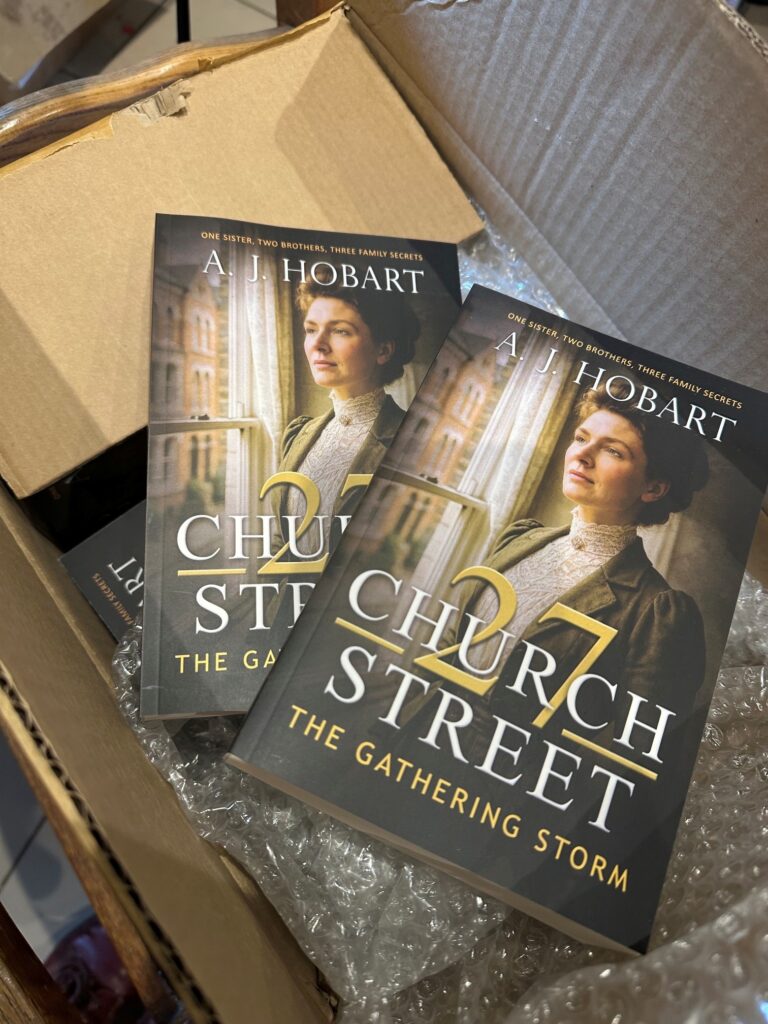
Freshly printed copies of Hobeck’s breakout title 27 Church Street
‘But we were struggling with storage costs,’ Rebecca says, adding that she felt Hobeck was experiencing ‘sporadic customer service quality’. Rebecca often liaises with printers in a freelance capacity as well, so she works with other large printers like CPI, which ‘is good for big print runs’; but Hobeck generally opt for smaller print runs – generally fifty to two hundred copies (with one notable exception – hooray for 27 Church Street!) – which are less suited to large commercial printers.
‘There’s not much out there bar Ingram Spark,’ Rebecca says, referring to printers that cater well to small print runs, ‘and the problem is they’re expensive, so there’s hardly any margin.’ Anecdotally, Hobeck found that ‘Bookshops do seem generally more reluctant to buy from Ingram Spark.’ Rebecca reasons that this might be because with their Ingram account, the cost of accepting returns meant they didn’t allow this mainstay of the bookshop–small-press ecosystem; and although their books were priced with a wholesale discount for booksellers, ‘Ingram take a cut and Gardners take a cut; so the margin isn’t as good [for booksellers] as ordering direct from Gardners. So what’s in it for them?’
Finding themselves at a bit of an impasse, feeling that their POD set-up was preventing them from being stocked in any quantity, but priced out of commercial printing arrangements, and struggling with storage costs, Hobeck needed a new solution – which was something CMP was working on.
Rebecca explains that she spoke to Toby about the proposal (at that point just an idea), and found that the main appeal was the storage offer – free storage. For Hobeck, cutting costs was a priority, and this seemed to offer that. ‘The initial blocker,’ Rebecca says, ‘was that we would have to make an agreement with Gardners.’ She explains that while their books were enrolled in the Clays’ scheme, ‘the agreement is between Clays and Gardners, while with CMP we would have to have an agreement with Gardners.’ She found herself worrying that the giant wholesaler might be reluctant to liaise with her directly.
“The initial blocker was that we would have to make an agreement with Gardners… it was quite straightforward”
‘I’d worked with Gardners before,’ she says, ‘getting consignment agreements for other presses – so maybe I was lucky, but I wrote to my contact there, and it was quite straightforward.’ After a conversation with her contact at Gardners, ‘I went to Toby with that agreement in place.’
In a Teams meeting with Gardners, ‘I explained about CMP, and they were interested. Gardners also have problems with other printers, and they said they like that [the CMP scheme] is easy – they’re happy with it.’
The paperwork consisted of ‘a couple of forms – not actually that much,’ says Rebecca, and it was up and running in two or three days. ‘Once we got the go ahead, since then I’ve been in regular contact with them. If I ask about pre-orders, they’re happy to tell me – numbers, not who, of course – and it’s really informative.’
After that, what was needed to get the ball rolling was some paperwork with CMP – ‘But that was easy, not much paperwork,’ she says. Once the two agreements were in place the scheme was simple.
The working relationship is such that Gardners send a purchase order – and Rebecca notes, ‘If I ask they will send a PO for the exact amount in a box,’ so if there are twenty-two copies in a box the order will be adjusted for twenty-two copies rather than twenty. Rebecca notes that this is important because it avoids sending a ‘split box’ – which incurs an admin charge from CMP for having to repack boxes into custom amounts. (She notes that her agreement with Clays had a similar charge.) ‘So it’s in your interest to convince Gardners! And they’ve been very flexible.’
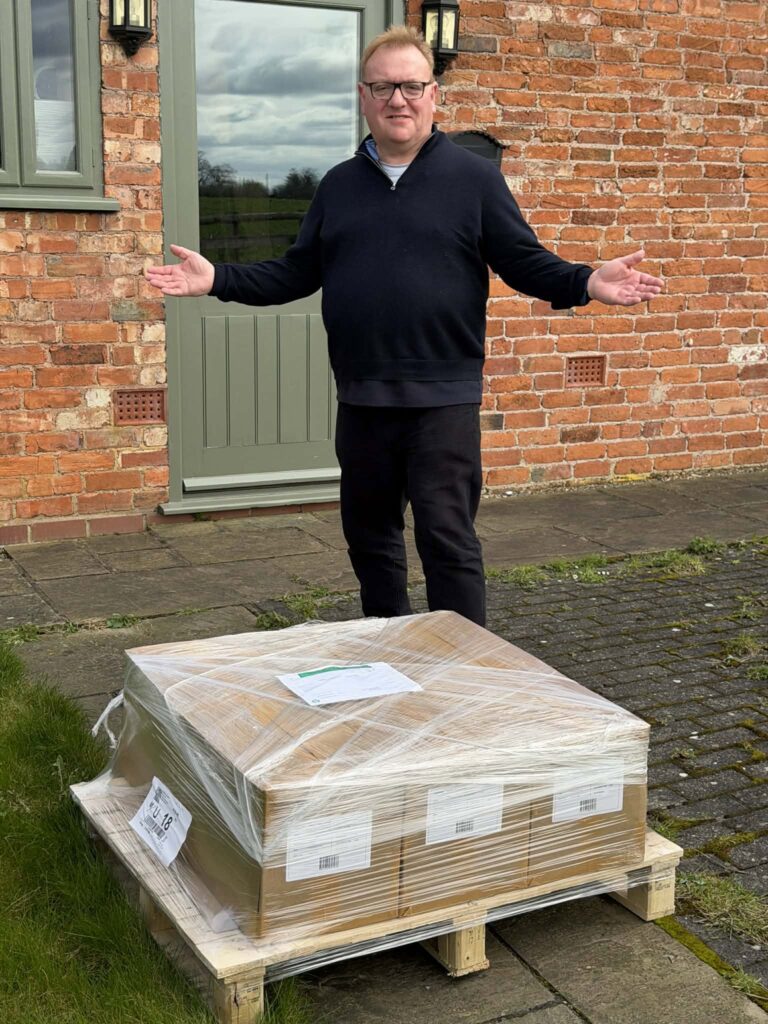
Fellow publisher Adrian Hobart with the locally famous pallet of books
Toby clarifies, ‘Rebecca is right about split boxes – if you want to send, say, a hundred copies in four full boxes of twenty-five, that’s fine; but if you want ten copies and that means splitting down a box, there’s a small charge for that, for the time it takes. But I should say there are no limits on quantities – we can send a pallet if needs be!’ Rebecca laughs, recalling the arrival of a pallet to Hobeck HQ, to the amusement of their neighbours. Toby agrees that Gardners have been very flexible in adjusting quantities. ‘Probably forty-nine out of fifty times it’s worked,’ he says, and Gardners have adapted the purchase order to match the box quantity.
When Rebecca receives a purchase order from Gardners, ‘I send it to Toby – I get a quick reply – and then there’s another email from CMP to say the order is in the system; then it’s sent and I can check on DPD and know when it’s arrived.’
Rebecca notes it’s quick and efficient – ‘And another thing I’d say is reprints are very easy. I just tell Toby I want to reprint a hundred copies and it’s in the system.’
“For the amounts I print with CMP it’s much more cost-effective than POD… And the quality is better”
Costs have come down: Hobeck has avoided split-box charges by liaising with Gardners; there are no storage charges, and ‘For the amounts I print with CMP it’s much more cost-effective than POD. There’s a good £1.50 in the margin – it is worth it for us. And the quality is better.’
Rebecca notes that as the scheme evolves she would like to see an automated stock report come through; as things are, she can ask Toby, and gets a quick answer, but notes that Clays send a monthly stock report, so she had been used to this.
Toby says that while the service is still evolving this has been on the back-burner, but it is something the team are working on a solution for; for the time being, they’re happy to field questions about stock held when a press needs to know, and when a title runs out of stock the press is notified.
‘So other than that we’re completely happy,’ Rebecca continues, ‘the quality, the speed to print and to get books to Gardners is really good. And communications are really good – much better than some other printers I’ve worked with.’
Availability codes are vital to stockists, of course; and many small presses bemoan the fact that most POD titles show up on Gardners as ‘extended catalogue’ or ‘special order line’, stamped ‘firm sale’ – and feel this discourages some booksellers from ordering. Happily, since switching titles over to the CMP scheme, Rebecca says, ‘I feel quite confident in saying that sales of the books we have printed with CMP since we signed the consignment agreement with Gardners are on a par with sales of those titles that feed through via Clays’ consignment agreement.’ It is perhaps still early days, but for Hobeck’s titles it seems this has been a real solution for feeding through an ‘in stock’ status.
“The hope is it will always be simple and work for publishers”
It feels important to ask what the implications will be on building the scheme as more publishers join after this trial period – will space become an issue moving forwards? Will the dreaded slow-moving title charges some distribution companies levy sneak in? Toby shakes his head. ‘Listen, we’re certainly not planning anything like that,’ he says; ‘the hope is that we can keep it very simple, very low tech – so that we can manage this on top of everything else we do. We don’t want to be spending lots of time on invoice queries and changes in terms. The hope is it will always be simple and work for publishers.’
In terms of the physical space the books take up, he says, ‘Well, we have a good amount of space – although of course it is limited, we’re not using much yet. I suppose we could eventually end up with a full warehouse – but that would be a nice problem to have! It wouldn’t be a case of “no more” – we would explore other solutions. But yes, we’re being cautious at the moment, and limiting to the Indie Press Network for now.’ It sounds like a slow approach is sensible, but it’s reassuring to know that the scheme is growing slowly and organically – with less chance of mitigations creeping in.
“It’s built to be simple and low tech and transparent”
So what are the ‘guardrails’ that CMP are putting on the scheme? ‘There are some requirements – you’ve got to print the books with us, of course; you don’t have to be an IPN member – but then we’re not really advertising it outside the IPN at the moment. It’s all about the books and the relationships for us – not using storage as a revenue stream. So there’s no nasty fine print – it’s about looking at everyone on a customer-by-customer basis, thinking about volumes and requirements before committing, because of course we need to store the books we print; but there’s no obligation to use us exclusively. It’s built to be simple and low tech and transparent. Provided you print with us, we’re happy to house your books, and we’ll be a trustworthy and reliable partner.’
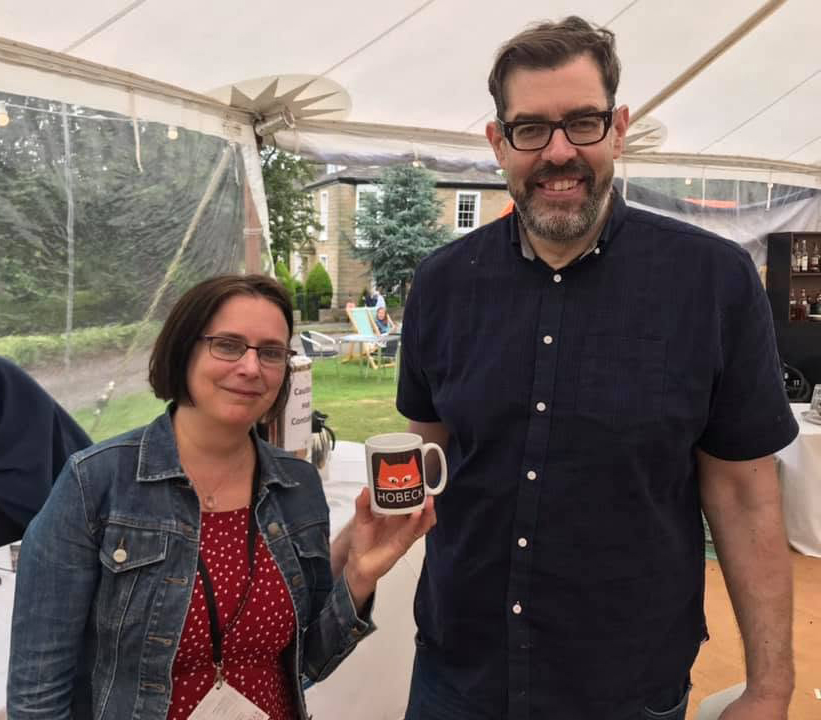
Rebecca presenting Hobeck merch to Richard Osman at Harrogate
Nodding to what Rebecca said about customer service being of key importance, Toby says, ‘We must never get to a point where service is starting to strain.’ To this end, they’re still treading cautiously: ‘Technically the caveat is that it’s on a customer-by-customer basis;’ Toby says, explaining that the thinking in each instance is, ‘Whoever’s next, have we got the space, do we understand the publisher’s business, are we the right partner?’ CMP see the scheme being ideally suited to presses with ‘relatively few titles and short print runs,’ and less for those printing ‘thousands and thousands of copies’. ‘We’re not at the moment rolling this out to customers with backlists of several hundred titles and thousands of copies of each – but that’s not us, anyway.’ He explains that CMP’s ethos is not about trying to be the perfect printer for every book, every press, but about striving to be the perfect partner for smaller presses. ‘It’s about offering a scheme which complements our existing strengths.’
In summary, and asked to consider obstacles or bumps on the way, both Toby and Rebecca say that it’s been easier than they had anticipated. ‘Rebecca is right,’ Toby says. ‘I thought, wrongly, that the Gardners element might be more difficult to overcome. That’s what had always put us off setting something like this up in the past – I was always aware that Clays have a relationship with them, and a critical mass – can we offer a solution that works? But after Rebecca’s conversations it was clear – it’ll work!’
On an ongoing basis, Toby says, the practicalities of the agreement are designed so that it all boils down to a handful of emails per week. ‘CMP tries to always respond within twenty-four to forty-eight hours – so if you write to us now’ – that is, 11.30 a.m. – ‘your request will likely be actioned today, and definitely no later than tomorrow. And then we rely on DPD. You eventually have to trust the man in the white van!’ Of course this is the case with any print job (even POD titles need delivering!), and Rebecca notes DPD’s service is user-friendly; she clarifies that at this point in the process she receives tracking information direct from DPD.
Another key point to remember, Toby says, is ‘It’s worth pointing out that we don’t just ship to Gardners; we’ll send to any UK address – in fact, we can send books overseas too. We’ve sent to bookshops, to authors, to publishers… And of course we can add their information on to the tracking.’
On practicalities, Rebecca says it’s been very straightforward transitioning from POD to CMP’s scheme on a title-by-title basis. Hobeck use Nielsen’s Title Editor rather than an ONIX provider, so all it entails is logging into Title Editor and changing the title’s information from Ingram to Gardners.
“There are no limits apart from affordability – whatever we offer for five hundred copies is available for fifty”
Both Rebecca and Toby highlight that quality of production is an important factor too. For many, ‘POD’ has been synonymous with limited production options; whereas by producing the books in a short or mid-sized run, as opposed to a POD sausage factory, CMP can provide a better quality, and the full spectrum of production choices is available. ‘There are no limits apart from affordability – whatever we offer for five hundred copies is available for fifty,’ Toby says.
From Rebecca’s description of the scheme and Hobeck’s experience, what seems valued the most is communication. ‘It’s much more human,’ she says. ‘Whatever you think of the quality of POD, you might not get to talk to a human, depending on the company.’
Toby says CMP is well aware of this, and it’s key to them too. ‘I agree. I like dealing with humans! So often, I think small presses are left to feel unimportant and lost in the melee – I’m not surprised it’s a growing issue. Our offer won’t be right for everyone – but we’re trying to do something that’ll be useful for lots. If people can take advantage of it, then great.’
Rebecca points out another adjacent CMP scheme, which is the new marketing round-up they send out highlighting recently printed books – ‘I love the IPN round-up – featuring the books in social media!’
Toby smiles. ‘We see the IPN as our spiritual home! We enjoy the process of getting your books out there, and we’re chuffed to be part of that process.’
Contacts
Toby Culff, CMP Books https://www.cmp-uk.com | Toby@cmp-uk.com
If you’re an IPN member and need to be in touch with Gardners about setting up the scheme, please contact us
Disclaimer and transparency
Information for this article were given in conversation on the 12th of August 2026. As an evolving scheme the information will likely be subject to change. Neither the writer nor the Indie Press Network are affiliated with CMP, so this is not an advert, and it aims to be unbiased, based on the scheme’s merits.