



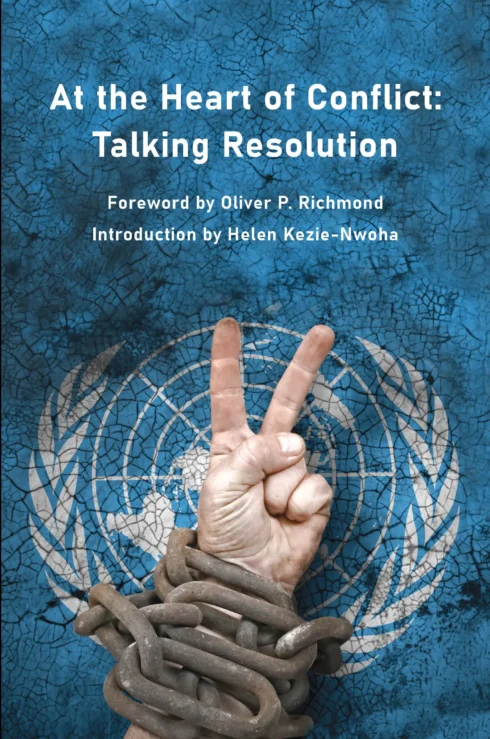


A the Heart of Conflict: Talking Resolution
A ground-breaking new book that dares to bridge the divide between peacemakers and military strategists.
As the world reels from an unprecedented surge in destructive wars and international crises, a new and critically important book challenges conventional wisdom and asks: Can peace be built by dialogue alone? When is the use of force necessary? Is there cause for hope? With 20 unflinching first-person accounts, the book uniquely gives voice to both sides of the conflict resolution debate from seasoned UN negotiators and grassroots peacebuilders to intelligence experts and military veterans.
This book is an essential read for those studying conflict resolution, international relations, or working in the field, looking to know more about the lived experiences of UN officials, translators, ambassadors, NGOs and military personnel.
Edited and compiled by Cheryl Robson
REVIEWS
“At the Heart of Conflict: Talking Resolution is a profoundly hopeful book. In these pages, we hear directly from practitioners who have not only witnessed conflict but have actively worked to transform it. Their voices bring a rare depth and texture to our understanding of mediation and peacebuilding — grappling with the political conditions on the ground and reflecting on how those moments fit into larger historical arcs. These accounts offer more than technical and political insight — they remind us that in the midst of violence and fragility, there are always individuals building bridges, nurturing resilience, and creating space for hope.”
– Dr Christine Cheng, War Studies, King’s College London
“A fascinating insight into the challenging world of conflict resolution that is likely to be as relevant tomorrow as it is today.”
-York Membery, writer and journalist, Sunday Times.
Introduction by Helen Kezie-Nwoha
Helen is a feminist scholar, peace-builder, and human rights advocate with over two decades of experience advancing gender equality in conflict and post-conflict settings. She is the Founder and Lead Researcher at Researchers Without Borders and former Executive Director of the Women’s Inter-national Peace Centre. Her work spans Africa and beyond, providing strategic policy advice to regional institutions such as the African Union, particularly on the implementation of the Women, Peace and Security agenda. Helen currently serves as the Chair of the Gender is My Agenda Campaign (GIMAC) at the African Union and is a member of FEMWISE, the African Network of Women Mediators. She holds a Ph.D. in Women and Gender Studies from Makerere University and has published extensively on feminist peacebuilding, political participation, and transitional justice. Through her leadership and scholarship, she has influenced national and regional policies that centre women’s voices in peace processes and governance.
Foreword by Oliver P. Richmond
Professor Oliver Richmond is a renowned scholar in International Relations, Peace, and Conflict Studies. He is the founder of the MA in Peace and Conflict Studies at the University of Manchester, where he also teaches core modules in the Department of Politics. Recognized for his significant contributions to the field, he received the 2019 Eminent Scholar Award from the International Studies Association. With extensive fieldwork experience in conflict zones, he has worked closely with international organizations, including the UN, and civil society groups.
Richmond’s publications include The Grand Design: Peace in the 21st Century (Oxford University Press, 2022) and Peace in International Relations (Routledge, 2020, 2nd ed.).
He has led several global research projects, including the AHRC-funded The Art of Peace and the Blockages to Peace projects. He also serves as a Visiting Professor at several prestigious universities, and co-edits key academic journals.
Afterword by Jonathan Cohen
Jonathan Cohen is Executive Director of Conciliation Resources, a post he took up in 2016. Over the past 28 years at Conciliation Resources, initially as Caucasus Director and then as Director of Programmes, Jonathan has supported dialogue and peacebuilding
initiatives in contexts including the South Caucasus, Kashmir, the Philippines, Colombia, Ethiopia, and Papua New Guinea.
Previously he served as Deputy Director of the Foundation on Inter-Ethnic Relations in The Hague, working with the OSCE High Commissioner on National Minorities. Jonathan is an Associate of the Institute for the Public Understanding of War and Conflict
at the Imperial War Museum, a member of the Advisory Board of the School of Slavonic and East European Studies at the University of London and a Board Member of the Peace Dividend Initiative. From 2018-2024 Jonathan was Chair of the European Peacebuilding Liaison Office (EPLO), a network of 55 peacebuilding organisations.